



Independent Lab Testing & Safety Report
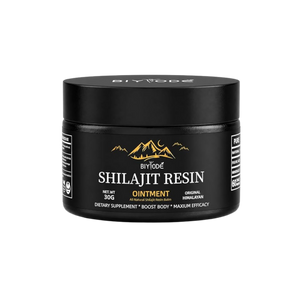
The complete Eurofins certificates of analysis for our Shilajit Resin, Lot 2232-132: heavy metals, microbiology, and fulvic acid content, explained in plain English, with the original PDFs published in full below.

What the reports actually show
- Every heavy metal tested came in well below USP oral daily-exposure limits. Arsenic and lead, the two highest, each sit at a small fraction of their permitted daily exposure at normal use.
- Pathogens were Absent: E. coli and Salmonella both undetected, with yeast & mold under 100 CFU/g.
- Fulvic acid measured 34.52% by dry weight, consistent with a genuine humic mineral matrix.
- All testing performed by Eurofins, an ISO/IEC 17025-accredited laboratory. Both certificates are published unmodified below.
Contents
Certificates of Analysis, Published in Full
Below are the unredacted Eurofins certificates for Lot 2232-132, exactly as issued. Page through them in the reader, open them in a new tab, or download the original PDFs.
Heavy Metals Testing
Shilajit is a mineral-origin substance that forms in high-altitude rock over long periods, so trace elements can be present. This is expected for any earth-derived product. The meaningful question is not whether trace metals appear at all, but whether they fall well within the ranges toxicology considers safe for daily use. Every element below was measured against USP <2232> permitted daily-exposure guidance.
Method: ICP-MS
Analysis used Inductively Coupled Plasma Mass Spectrometry (ICP-MS), following AOAC Official Methods 2011.19, 993.14, and 2015.01. ICP-MS is a recognised gold standard for trace-element detection, measuring at parts-per-billion precision.
Results, Lot 2232-132
Reported in Eurofins Report 5428992-0, Elements by ICP Mass Spectrometry, at a 300 mg serving size:
| Element | Measured | Per 300 mg serving | Result |
|---|---|---|---|
| Arsenic (As) | 775 ppb | ~0.23 µg | PASS |
| Lead (Pb) | 720 ppb | ~0.22 µg | PASS |
| Cadmium (Cd) | 66.9 ppb | ~0.020 µg | PASS |
| Mercury (Hg) | 17.3 ppb | ~0.0052 µg | PASS |
Source: Eurofins Report 5428992-0, Lot 2232-132, tested July 2026. Method: ICP-MS per AOAC 2011.19, 993.14, 2015.01 (Modified). Per-serving figures are calculated from the reported concentration at the 300 mg serving size on the certificate.
Even at two servings per day (600 mg), daily exposure for every element stays a small fraction of its USP <2232> permitted daily exposure: arsenic around 3%, lead under 10%, cadmium under 1%, and mercury negligible.
Microbiology Testing
Microbial safety, pathogenic bacteria, yeast, and mold, is a separate dimension from heavy metals. Testing follows USP current-revision chapters 2021 and 2022. Before reporting an absence, the lab first validates that its method can detect the organism in this specific matrix (a "suitability" test), so a reported absence is a true negative, not a testing artifact.
| Test | Method | Result | Status |
|---|---|---|---|
| Aerobic Plate Count | USP Ch. 2021 | 8,600 CFU/g | Within limits |
| Escherichia coli | USP Ch. 2022 | Absent / 10 g | PASS |
| Salmonella | USP Ch. 2022 | Absent / 10 g | PASS |
| Combined Yeast & Mold | USP Ch. 2021 | < 100 CFU/g | PASS |
| APC Suitability | USP Preparatory | PASS | Validated |
| E. coli Suitability | USP Preparatory | PASS | Validated |
Source: Eurofins Report 5381929-0, Lot 2232-132, May 2026.
Fulvic Acid Content
Report 5381929-0 reports Fulvic Acid at 34.52 g/100g (34.52% by dry weight) for Lot 2232-132, measured using the IRXNK fulvic acid method.
Fulvic acid is the low-molecular-weight fraction of humic substances, carrying a high density of oxygen-containing functional groups that let it bind minerals and support nutrient transport. A result of 34.52% means slightly more than one-third of the resin's dry mass is measurable fulvic acid, which is substantial for a natural mineral-origin product.
Fulvic acid percentage is a compositional purity marker, not a direct measure of biological activity. It confirms a genuine humic mineral matrix rather than a synthetic reconstruction.
Testing Laboratory Credentials
Both certificates were issued by Eurofins Food Chemistry Testing Madison, Inc., 6304 Ronald Reagan Ave, Madison, WI 53704, authorised on behalf of Eurofins by Edward Ladwig, President. The Madison facility holds accreditation number 2918.01 under the ILAC Mutual Recognition Arrangement.
- External audits by an independent national accreditation body
- Demonstrated proficiency through inter-laboratory comparison programs
- Documented and validated analytical methods for each test
- Measurement-uncertainty statements available on request
- Results that carry evidentiary weight in regulatory contexts
The Eurofins Sample IDs on each certificate are assigned independently by the lab, and testing was performed by Eurofins as an independent third party.
Comprehensive Results Summary
Every parameter for Lot 2232-132 on one page, drawn directly from the two published certificates.
| Category | Parameter | Result | Reference |
|---|---|---|---|
| Heavy Metals | Arsenic | 775 ppb ✓ | USP <2232> |
| Heavy Metals | Lead | 720 ppb ✓ | USP <2232> |
| Heavy Metals | Cadmium | 66.9 ppb ✓ | USP <2232> |
| Heavy Metals | Mercury | 17.3 ppb ✓ | USP <2232> |
| Microbiology | E. coli | Absent /10 g ✓ | USP: Absent |
| Microbiology | Salmonella | Absent /10 g ✓ | USP: Absent |
| Microbiology | Yeast & Mold | < 100 CFU/g ✓ | USP limit |
| Composition | Fulvic Acid | 34.52 g/100g ✓ | Purity marker |
How to Verify Your Lot
Every jar carries a Lot Number printed on the label. The results here apply specifically to Lot 2232-132. To verify any lot:
Match the Lot Number on your label to the COA header above.
Confirm the laboratory name: Eurofins Food Chemistry Testing Madison, Inc.
Check the accreditation number: 2918.01 (ILAC MRA).
Note the Receipt and Date-Started fields, which confirm the COA corresponds to actual batch testing.
Review the numeric results, not just the status, against the reference limits.
Common Questions
Yes, in trace amounts, and that is expected for any mineral-origin product. What matters is the level. In Lot 2232-132, every element measured well below USP daily-exposure guidance at normal use.
It means no organisms were detected in a 10-gram test portion, and the lab first validated (through a suitability test) that the method could detect them in this matrix, so the absence is a true negative.
It confirms a genuine humic mineral matrix, with over a third of the dry mass being measurable fulvic acid. Note that fulvic percentage is a purity marker, not a bioactivity score.
Yes. The Eurofins PDFs for Lot 2232-132 are embedded above. Page through them, open in a new tab, or download the originals.
Eurofins Food Chemistry Testing Madison, Inc., an ISO/IEC 17025-accredited laboratory (accreditation 2918.01).