



Shilajit Gummies and Natural Testosterone Support: What the Research Actually Shows
Biyode Research team
introduction:
Testosterone has become one of the most talked-about hormones in men's health, and the supplement aisle has responded with an entire category of "T-boosters" promising to reverse the decline. Shilajit gummies have entered that conversation too, but for a different reason than most of the products sitting next to them: shilajit isn't a stimulant or an isolated ingredient trying to force a hormonal spike — it's a mineral-rich resin whose proposed mechanism is slower, broader, and grounded in a genuinely interesting (if still limited) body of clinical research.
This guide walks through what's actually known about shilajit and testosterone, how the gummy format fits into that picture, and how to separate the legitimate research from the marketing built on top of it.
Why Testosterone Has Become a Bigger Conversation
Population-level data has documented a gradual decline in average male testosterone over recent decades, a trend researchers have linked to a combination of factors: rising obesity rates, chronic stress, environmental exposure to endocrine-disrupting chemicals in plastics and certain pesticides, and nutrient-poor modern diets. A 2025 systematic review examining the relationship between metabolic health, obesity, and reproductive hormones described this as a cyclical relationship — declining metabolic health contributes to lower testosterone, and lower testosterone can, in turn, make weight and metabolic management harder, reinforcing the cycle.
The European Association of Urology's clinical guidelines have similarly emphasized that lifestyle and environmental factors are meaningful, modifiable variables in male reproductive health — not just an inevitable consequence of aging. This is the framing that positions mineral-based support, like shilajit, as a reasonable area of interest: if part of the decline is tied to genuine nutrient and mineral gaps rather than pure biological aging, then addressing those gaps is at least a plausible piece of the puzzle.
What the Shilajit-Testosterone Research Actually Says
The most frequently cited study in this space is a 2016 trial published in Andrologia (Pandit et al.). It's worth describing exactly what it found, since it's often summarized in ways that overstate its scope:
- The trial enrolled 75 healthy male volunteers aged 45 to 55.
- Participants took purified shilajit daily for 90 days.
- Compared to the placebo group, the shilajit group showed a 23.5% increase in total testosterone and a 19.14% increase in free testosterone.
- The study also documented increases in follicle-stimulating hormone (FSH) and dehydroepiandrosterone (DHEAS), both markers involved in the broader hormonal cascade.
This is a genuinely notable result, and it's one of the more specific, quantified pieces of clinical evidence in the shilajit literature. But a few caveats matter for interpreting it responsibly:
- The study population was healthy men aged 45–55. Results in this specific age and health range don't automatically generalize to younger men, men with diagnosed hypogonadism, or men with unrelated hormonal conditions.
- One well-designed trial is meaningful, but it isn't the same as a large body of independently replicated research. Responsible interpretation treats this as a strong, promising data point rather than settled, universally applicable science.
- The mechanism proposed (mineral cofactor delivery plus mitochondrial support) is plausible and consistent with what's known about zinc, magnesium, and selenium's roles in testosterone synthesis — but the trial demonstrates an association with shilajit supplementation, not a fully mapped, step-by-step causal pathway.

The Proposed Mechanism, Explained Simply
Shilajit's relevance to testosterone production is generally explained through two pathways:
- Mineral delivery. Testosterone synthesis depends on specific minerals functioning as enzymatic cofactors — zinc, magnesium, and selenium are the most commonly cited. Shilajit's fulvic acid has a chelating property that converts minerals into an ionic form the body can absorb more readily than the synthetic mineral salts found in many standard supplements. The idea is that if mineral status is a limiting factor for someone, improving its availability could support the underlying hormone-production process.
- Mitochondrial energy support. Hormone production, including testosterone synthesis in the testes, is an energy-intensive cellular process. Shilajit's dibenzo-α-pyrones (DBPs) are studied for their potential role in supporting the mitochondrial electron transport chain — the mechanism your cells use to generate ATP. The reasoning is that better-functioning cellular energy production could support the broader endocrine cascade, not just testosterone specifically.
This two-pathway framing is why shilajit is generally described as an adaptogen and mineral replenisher rather than a stimulant — it isn't trying to force a spike the way an isolated, high-dose ingredient might; it's aimed at supporting the underlying systems that regulate hormone production more broadly.
How Shilajit Differs From Typical "T-Booster" Supplements
Most commercial testosterone-support products lean on a small number of isolated, often high-dose ingredients — zinc, magnesium, D-aspartic acid, and various herbal extracts — usually formulated to try to stimulate one specific pathway. Shilajit's proposed approach is broader:
|
Factor |
Typical T-Boosters |
Shilajit Gummies |
|
Source |
Isolated synthetic vitamins, single herbal extracts |
Naturally occurring mineral resin |
|
Mechanism |
Attempts to stimulate one specific pathway |
Broad-spectrum mineral delivery + mitochondrial support |
|
Key compounds |
High-dose zinc, magnesium, D-aspartic acid |
Fulvic acid, dibenzo-α-pyrones, 80+ trace minerals |
|
Bioavailability |
Often limited, depending on the mineral form used (e.g., oxides) |
Generally higher due to fulvic acid's chelating action |
|
Onset |
Often marketed as fast-acting |
Gradual — most research and anecdotal reports describe weeks, not days |
|
Purity risk |
Fillers, binders, undeclared ingredients |
Heavy metal contamination risk if unpurified — requires third-party testing |
Neither approach is inherently "better" in an absolute sense — but they're built on different theories of what's actually limiting testosterone production for a given individual, which is worth keeping in mind before assuming either one will address your specific situation.
Global Context: What the Data Shows
Source: Our World in Data — open global research and statistics (CC BY).

Healthy life expectancy — years lived in good health — diverges sharply from total lifespan in many regions. Cellular energy metabolism, including mitochondrial efficiency during sleep, is a foundational driver of the gap between living long and living well. Supporting the overnight ATP recharge cycle is one mechanism that may narrow that gap at the individual level.
Why Shilajit Gummies Specifically
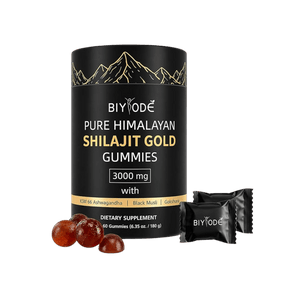
Traditional shilajit resin is potent, but it's genuinely inconvenient to use consistently: it has a strong, bitter, earthy taste that most first-time users find jarring, it needs to be dissolved in warm water or tea before use, and its texture shifts with temperature — hard when cold, soft when warm — making daily dosing more of a small ritual than a quick habit.
That inconvenience matters here specifically because the clinical trial behind the testosterone findings used 90 days of consistent daily supplementation — this isn't a short-term intervention, and skipped days almost certainly matter for whether any effect materializes. Shilajit gummies solve the consistency problem directly:
- Pre-measured, standardized dosing — no eyeballing a pea-sized resin portion.
- Masked bitterness — natural flavoring covers the taste that turns many people off resin.
- No prep required — no dissolving in hot water, no waiting.
- Easier to sustain for a 90-day timeline — which matters far more here than in supplement categories with faster feedback loops.
The active compound profile is the same regardless of format, provided the gummy uses a properly standardized, adequately concentrated shilajit extract rather than a diluted one — which brings us to the quality question.

What to Look for in a Shilajit Gummy
The shilajit market has a well-documented authenticity problem, with a substantial share of products sold online, particularly under generic "Himalayan shilajit" labeling, turning out to be diluted, mislabeled, or simply fulvic acid powder mixed with fillers rather than a genuine mineral-resin complex. Given that the clinical evidence involves purified, standardized shilajit specifically, sourcing quality isn't a minor detail — it's central to whether a product could plausibly replicate anything close to the studied effect. Look for:
- A named, standardized extract with a stated fulvic acid percentage, not vague "shilajit powder" wording.
- Third-party lab testing for heavy metals (lead, arsenic, mercury, cadmium) — since unpurified shilajit's rock-strata origin carries a genuine contamination risk.
- Transparent sourcing, naming a specific documented region (Himalayan or Altai sources are the most commonly referenced).
- A short, recognizable ingredient list, without a long tail of artificial fillers.
- Realistic marketing language. Be skeptical of claims promising a fast, dramatic testosterone spike — the underlying research this category is built on involved 90 days of consistent use, not an overnight change.
How to Use Shilajit Gummies for This Purpose
- Standard dosing is generally equivalent to a 250–500mg resin serving per gummy or daily serving — check the specific label, since potency varies by brand.
- More is not better. Exceeding the labeled dose doesn't accelerate results and isn't advised.
- Plan for a multi-week to multi-month timeline. Based on the clinical trial discussed above, meaningful hormonal changes were measured after 90 days of consistent daily use — a much longer runway than many supplement categories require before judging effectiveness.
- Take it consistently, ideally at the same time each day, to build it into a sustainable routine rather than something easily forgotten.
Safety Considerations
- Hemochromatosis (iron overload), active gout, and Wilson's disease are conditions where shilajit's mineral content, including iron and other trace minerals, makes it inappropriate without medical guidance.
- Not recommended for children under 12, or for pregnant or breastfeeding women, due to insufficient research in these populations.
- Medication interactions are a real consideration for anyone taking diabetes medication, blood pressure medication, or blood thinners — shilajit can influence metabolic and circulatory systems, so a conversation with a healthcare provider is warranted before starting.
- This is not a substitute for medical evaluation. If you suspect clinically low testosterone — persistent fatigue, low libido, reduced muscle mass, mood changes — that's worth diagnosing through bloodwork and a doctor's evaluation, not addressing through supplementation alone. Shilajit gummies are reasonably positioned as a supportive, lifestyle-level addition, not a treatment for a diagnosed hormonal deficiency.
- Supplements are not FDA-approved to diagnose, treat, cure, or prevent disease. Shilajit gummies are regulated as dietary supplements, meaning specific health claims aren't independently verified by a regulator before reaching the market — which is exactly why the quality checklist above matters more than persuasive copy.

Conclusion
Of everything discussed in the broader shilajit supplement space, the testosterone research is genuinely one of the more specific and quantified pieces of evidence available — a well-structured, placebo-controlled trial in a defined population showing a measurable hormonal change over a 90-day period. That's a meaningful data point, and it's part of why shilajit has earned a distinct place in men's health conversations rather than being lumped in indiscriminately with every other "natural testosterone booster" on the shelf.
At the same time, one strong trial in a specific population isn't the same as a broad, universally applicable guarantee. The proposed mechanisms — mineral cofactor delivery via fulvic acid, mitochondrial energy support via DBPs — are biologically plausible and consistent with known nutrition science, but they describe a gradual, foundational process rather than anything resembling a fast-acting intervention.
That's exactly where shilajit gummies earn their place. Raw resin works, but its taste and handling make consistent, 90-day use genuinely difficult for many people — and consistency is the one variable the underlying research actually depends on. A properly sourced, standardized, third-party-tested gummy removes that friction, turning a three-month clinical protocol into something realistic to sustain as a daily habit.
If you're considering shilajit gummies for this purpose, choose a transparent, well-tested brand, commit to a multi-month trial rather than expecting a fast result, watch for the contraindications above, and get bloodwork and a doctor's evaluation first if you suspect a genuine hormonal deficiency rather than relying on a supplement alone to diagnose or address it.
" This article is for informational purposes only and is not medical advice. Consult a healthcare provider before starting any new supplement, especially if you have a pre-existing condition or take prescription medication.
- Researchers, Journal of Neurochemistry, 2023 (PMID 37953684)
Experience the Biyode Difference
Pure, Eurofins-tested Products from the UNESCO-protected Golden Mountains of the Himalayas. 180,000+ customers across 33+ countries trust our quality.
What Our Customers Say on ★Trustpilot
 Verified
2026-07-23
Verified
2026-07-23
Verified
2026-07-23
Verified
2026-07-23
Verified
2026-07-23
Verified
2026-07-23
Frequently Asked Questions About Why 8 Hours of Sleep is Useless if Your Cells Can't Recharge
Will shilajit gummies definitely raise my testosterone?
How long before I'd notice a change?
Should I get my testosterone tested before starting
Sources
- Clinical evaluation of purified shilajit on testosterone levels in healthy volunteers - Andrologia, 2016
- Stohs et al. (2021) The role of Dibenzo-alpha-pyrones in bioenergetics and antioxidant activity
- Shilajit: A Review on its Therapeutic Potential - International Journal of Ayurveda Research, 2010
These statements have not been evaluated by the Food and Drug Administration. This product is not intended to diagnose, treat, cure, or prevent any disease.